
OUR IMPACT
Hover over the pins to read more:

Our Network
We have sites located all across the Great Lakes and its waterways, from the St. Lawrence River to Lake Superior.


Informed Policy
Our data was cited in support of the Keeping Polystyrene Out of Ontario's Lakes and Rivers Act, 2021, requiring dock foam to be encapsulated to reduce the amount found in the lakes.
We are also contributing information on pre-production plastic pellets (or "nurdles") to prevent their loss into the environment.

Partnerships
The initiative and its measurable impact would not be possible without our network of partners and sponsors! We are thankful for a diverse group of collaborators and supporters.

Supporting Early Career Scientists
The Great Lakes Plastic Cleanup is committed to supporting the next generation of environmental scientists and researchers. For example, each summer, we bring on a team of Community Engagement Coordinators to engage their local communities in the fight to end plastic pollution. Since 2022, we have created 10 jobs across the Great Lakes region, empowering emerging leaders to make meaningful contributions to the field of plastic pollution research and environmental protection.

Technology & Innovation
The Great Lakes Plastic Cleanup is at the forefront of piloting innovative technology in our efforts to combat plastic pollution.
Some of our plastic capture technologies can travel when not in use so more communities see them firsthand!
.png)
Public Outreach & Experiential Learning
By hosting or attending events at schools, camps, farmers markets, festivals, and more, we are able to engage audiences of all ages on the issue of plastic pollution!

Volunteer Program
We provide opportunities for volunteers to come out and help us sort and characterize the plastic debris collected by our technologies. From student groups to corporate team building events, our awesome volunteers help contribute to filling critical data gaps in the Great Lakes! Get involved today!

Scientific Impact
We often share the debris collected by our plastic capture technologies with academic institutions for further research. It may be used by researchers to examine the sources, exposure, fate and transport of plastics, and even how microorganisms and enzymes can break down plastic!

Our Network
We have sites all across the Great Lakes and its waterways, including Lake Superior
The Great Lakes Plastic Cleanup is contributing to lasting, tangible impact across the region. By preventing and removing plastic pollution, we are protecting one of the world’s most important freshwater ecosystems, while empowering communities to be a part of the solution.
Our impact goes beyond cleanup. The data we collect is helping shape research, inform policy, and drive broader systems-level action on plastic pollution. Together, these efforts are creating meaningful change for the Great Lakes and the communities, wildlife, and economies that depend on them.
We use innovative technology to effectively prevent plastic from entering the Great Lakes or that which is already there.
Our initiative utilizes five types of innovative technologies, each designed to target plastic and other debris in different environments, including in-water, shoreline, and upstream settings. With 162 devices deployed across more than 245 sites in Canada and the U.S., these technologies not only help remove pollution but also provide unique insights into how debris varies by location.

By capturing data from different environments, we can better understand the types, sources, and pathways of plastic entering our Great Lakes, allowing us to tailor solutions more effectively.


_JPG.jpg)
Empowering Youth
By providing opportunities for students and youth groups of all ages to participate in engaging hands-on activities and educational sessions, we’re cultivating a strong sense of environmental responsibility and stewardship for the Great Lakes.
Over the years, we’ve attended and hosted a wide range of events across the Great Lakes region where we’ve connected with young people.
.jpeg)

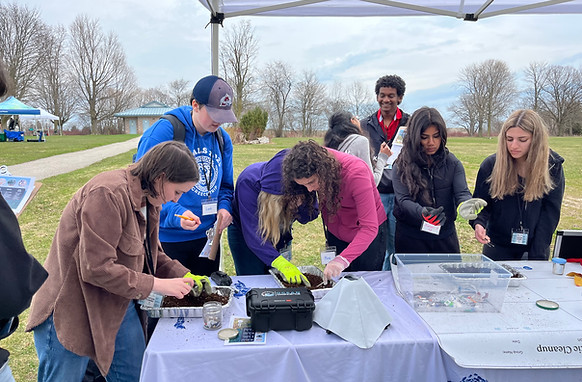
Great Lakes Student Conference 2025
Whitby, ON
Advancing Policy and Research in the Great Lakes
Data collected by our network has been instrumental in advancing policy to mitigate plastic pollution. Our data informed the Keeping Polystyrene Out of Ontario’s Lakes & Rivers Act, which requires that polystyrene used for floating docks be fully encapsulated.
We are also working to address pre-production pellet loss in the environment.

In collaboration with our academic partners, the initiative has also contributed to other important research on plastic pollution in the Great Lakes. Weathered plastic collected by the Great Lakes Plastic Cleanup has been used for various research projects, helping to further understanding on the effects of plastic on aquatic species, ecosystems, and human health.


The diCenzo Lab,
also at Queen’s University, used weathered plastic debris collected by the Great Lakes Plastic Cleanup to advance research on microbial biofilms that cling to the surface of microplastics. The study is looking to uncover microbes that could play a role in breaking down plastic.
The Great Lakes Plastic Cleanup is tackling plastic pollution through the piloting of innovative plastic capture technology, the collection of critical data and the engagement of local communities to collaborate on ending plastic pollution in our Great Lakes. Learn more about just some of the many ways that we're making an impact below.
Check out our local impact stories by using the buttons to filter by category and/or year:
Broader Impact: Learn about how we've contributed to efforts beyond our initiative, including through our partnerships, scientific contributions, and policy change. These collaborative efforts have been making a tangible difference in protecting the Great Lakes region.
Data Collection: Dive into where our community science efforts are providing valuable insights and better understanding of the sources, pathways and impacts of plastic pollution in the Great Lakes.
Technology & Innovation: Take a closer look at our use of cutting-edge technology to address plastic pollution in the Great Lakes.
Filter:
Broader Impact
Open Plastic Biotechnology
Open Plastic is a consortium at Queen's University looking to understand whether microorganisms and enzymes may be able to biodegrade plastic into recyclable components or chemicals. The Great Lakes Plastic Cleanup contributed samples of debris collected by our Kingston Seabins to this important research effort.

Broader Impact
Lake Ontario Student Conference
The 2022 Lake Ontario Student Conference was hosted by the Ganaraska Region Conservation Authority. The conference brought together students from across Ontario to spend the day learning about the Great Lakes, conservation and stewardship. The Great Lakes Plastic Cleanup provided an experiential learning activity for the students.


Broader Impact
Microplastics Fingerprinting Research Project
Through a collaboration with the University of Waterloo Microplastics Fingerprinting Research Project, plastic debris collected by our technologies was analyzed to better understand its chemical composition, and to determine whether specific additives and colourings can provide clues about what they were used for before finding their way into the environment.


Broader Impact, Data Collection, Technology & Innovation
Hands-on Experiences for Students
School events with the Great Lakes Plastic Cleanup bring children and youth outdoors for exciting STEM learning experiences. Pictured here are students from Spring Lake Elementary School in Michigan sorting debris from a beach cleaning robot!

Data Collection, Broader Impact
Our Community Engagement Coordinators
In 2022, we expanded our team to include community engagement coordinators in strategic locations. Coordinators have hosted 50+ events each summer, inviting members of the public to learn more about the issue of plastic pollution and how they can play a key role in addressing it.
